

Before we talk about boundaries as a practice, it’s worth naming something important: this work is lived, not just taught.
When we asked Gaia Toscano what “starting steady” looks like for her personally, she shared a moment from this very conversation. She had committed to a deadline for this post that she ultimately couldn’t meet — and instead of pushing through guilt or overextending herself, she paused, listened to her capacity, and set a new boundary.
That real-time example perfectly reflects Gaia’s approach. As a certified professional coach and co-owner of Essa Studios, she helps individuals and leaders build habits that support growth without burnout, blending mindset, embodiment, and practical structure.
In this conversation, Gaia explores what it means to train your boundary muscles, how posture and energetic boundaries are connected, and why steadiness — not perfection — is what actually creates lasting change.
E: Can you tell us a bit about your background and the work you do today?
G: I taught in various forms for many years and greatly enjoyed sharing my knowledge to help people grow. When I hit a “point of no return” in my personal life, I started therapy and my therapist suggested I would make a great coach. So, fueled by a thirst for further personal development, I embarked on this journey. Coming from a different country and speaking different languages helps me greatly to connect with people from all walks of life. Additionally, managing a business with employees really highlighted the importance of cultivating leadership and building structures to juggle multiple needs while trying to keep a balance in life.
E: We talk a lot about “work–life balance,” but what does that actually mean in practice?
G: We often think balance is this static, ideal status where every aspect of life has a perfect place and time. A perfect equilibrium. In practice, balance is a daily, constant act, much like the tightrope walker in a circus: one step you lean left, and the next you must counterbalance to the right. Same in real life: one day you might need to work more, one day your body is telling you to take it easy. To achieve and maintain a balanced life, we need to work at it daily. Creating healthy habits and setting boundaries are among the main tools we can use, and yes—we need to be compassionate with ourselves if things don't go as planned. Balance is not static or perfect; it requires continuous, steady adjustment on our end.
E: Our theme for January is “Start Steady.” How does this idea show up in the work you do with clients?
G: Your theme is so timely! Most of us have big yet often fleeting resolutions. When we set a goal, we need to break it into attainable steps, something that we can commit to, and work toward that goal daily with little bits of progress. It is like hiking a mountain: if you look at the peak, you lose motivation, but if you just keep walking, you will eventually reach the top. There might be detours, you might go up, then down, then up again, but if you are moving toward the top, you are on the right path. Choosing an easy first step builds motivation and momentum to keep you progressing toward your goal, therefore increasing your rate of success. When you look back at the steps you have already taken, you see how far you have already come.
E: Are boundaries something we can train, much like posture? Can you expand on that metaphor?
G: Absolutely! Our brain is an amazing, trainable wonder of nature. We can rewrite connections between our neurons and create new paths through repetitive behaviors. Just as we exercise our muscles to stay strong, we can go to the "brain gym" and perform "mental repetitions" to build new habits. Once we become aware of a behavior we want to change, it simply takes consistent practice to make that new boundary feel natural.
E: What are some common “boundary slouches” you see — especially in high-achieving women?
G: The most common "boundary slouches" I see in women are the tendency to prioritize everyone else’s needs over their own and saying "yes" when they truly want to say "no." High-achieving women often overextend themselves both at work and at home. This leads to higher stress, declining health, and eventual burnout. Part of this is nature (we are nurturing creatures), but much of it is culture. Society has conditioned women for thousands of years to be mothers and wives first, before being individuals. Because housework and childcare still fall majorly on us, many of us are essentially working two full-time jobs. Learning to stand tall in our boundaries is essential for our fulfillment.
E: What’s one small boundary practice someone can start this week that doesn’t feel overwhelming or confrontational?
G: Say “No”! Say no at least once a week - or better yet, once a day. It is a small boundary that can be set concisely - in fact, "No" can be a complete sentence. The key is to be clear about our needs and state them calmly but firmly. You don't need to provide a long explanation. You can set boundaries with compassion for others and for yourself. It can be a "no" to a date because you’re tired, or a "no" to washing the dishes because you need a bath. It doesn't matter how small the "no" is, as long as you practice it. A little discomfort at the beginning will go a long way toward your long-term peace.
E: In your experience, how are physical posture and energetic boundaries connected?
G: Our bodies, minds, and spirits are all one; a change in one realm inevitably affects the others. We hunch over and close our chests when we are sad, scared, or lacking confidence—we are physically protecting our hearts from the external world. We make ourselves smaller when we don’t want to be noticed. Conversely, we stand tall when we are happy and stay grounded when we are in "warrior mode."
When you take up physical space—shoulders down and back, chest open, feet hip-distance apart—you don't just exude confidence; you tell your brain that you are confident and worthy. Sometimes we must "fake it until we make it." Once we send that positive physical message to the brain, our thoughts shift, our emotions follow, and eventually, our actions change.
E: How can something as simple as checking in with your body during the day change how you show up mentally and emotionally?
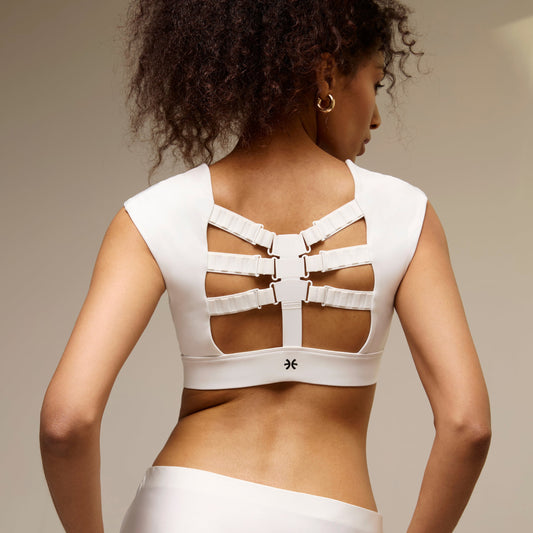
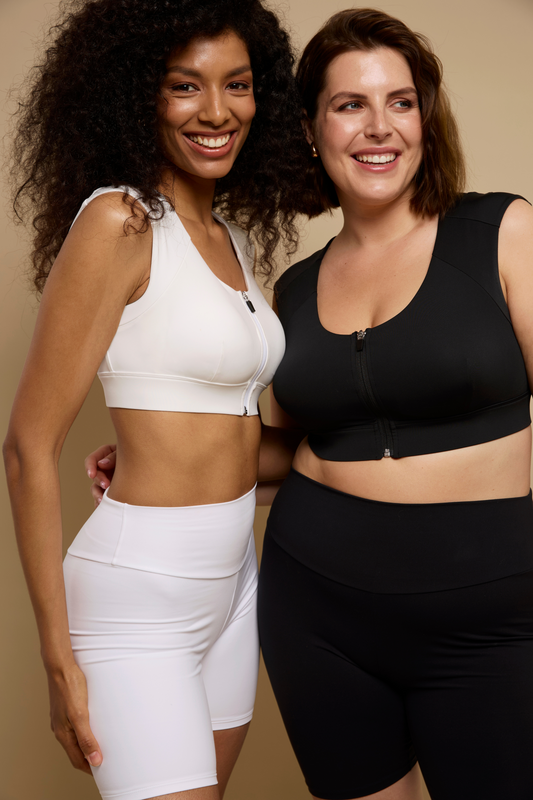
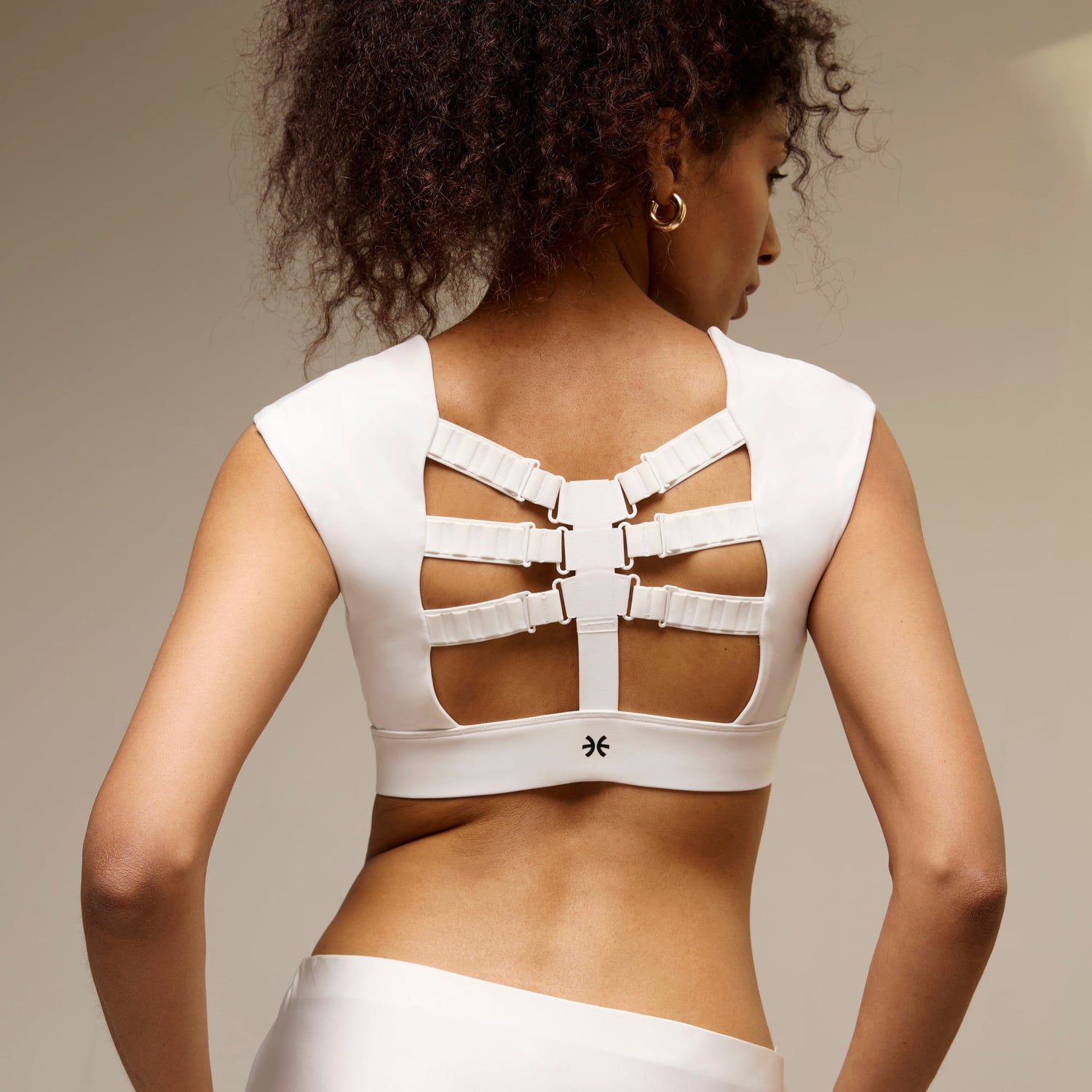
G: The first step toward change is always awareness. If I don’t check in with my body, I might work for eight hours without a single sip of water. Checking in—physically and emotionally—is the only way to become aware of what needs to change. Unhealthy posture is an epidemic today because of excessive screen time and sedentary work, which causes us to store stress in our necks and lower backs. Tools like The Etalon Posture Bra serve as a gentle, constant reminder to keep ourselves physically aligned so that we can remain more aligned with our lives
E: If someone notices themselves slouching — physically or energetically — what’s a gentle way to reset without judgment?
G: You can ask yourself: "What brought me here?" or "What is making me slouch?" Understanding the "why" helps silence our inner critic. Where we are right now is the result of our past experiences. We must treat ourselves with the same compassion we would show a best friend or a child. We are always doing our best with the knowledge and tools we have at the moment. To move toward a better outcome, we must honor, not judge, the imperfect present.
E: Many people start January with big intentions that don’t stick. From a coaching perspective, why does that happen, and how can we do it differently?
G: I believe this happens mainly for two reasons.
The first one is that we need to discover why we want something. Why those specific intentions? What truly lies underneath them? And underneath that layer? And one layer below that? When we really get to the core of what we love (our "Why"), then we have clarity. And clarity in our intentions is the absolute foundation.
The second point I see is that we tend to confuse our goals with our big dreams. Dreams are meant to be big; they fuel our passion for life. "Shoot for the sky, and you will land on the moon."
However, to move forward toward a dream, we have to break it down into manageable goals. To achieve those goals, we need to set small stepping stones. So, dream big, but start small and keep going.
We try to change everything at once through willpower, rather than building a system. Willpower eventually runs out. Real change happens when we focus on the small, daily process. When we set "steady" habits that are small enough to maintain even on our worst days, we stop relying on fleeting motivation and start building a lifestyle that lasts.
E: If someone takes just one thing from this conversation, what would you want them to remember about balance, boundaries, or alignment?
G: Balance is not a destination, but an active process, like walking a tightrope. Boundaries are the essential tools that help you stay on that rope.
As we move through January, what does “starting steady” look like for you personally?
Ah, I had to practice it myself!
I initially committed to answering these questions by a deadline that I simply couldn't meet. I felt horrible for not meeting it, overwhelmed, and guilty for falling behind.
I was "falling off the rope" by being constantly available even when I didn't have the capacity.
I had to set a new, attainable deadline for myself—that was my boundary.
So, "starting steady" for me looks like acknowledging that we are all learners on the same path.
It isn't about being perfect; it’s about the journey and having the compassion to realign ourselves whenever we need to.
CONNECT WITH GAIA ON LINKEDIN >
Starting steady doesn’t mean never wobbling.
It means noticing when you’ve leaned too far, responding with compassion, and gently realigning. Boundaries, like posture, aren’t a one-time fix — they’re a daily practice that helps you stay upright, supported, and present in your life.
As Gaia reminds us, balance isn’t something you arrive at. It’s something you build, one small, steady adjustment at a time.
Trending


Try Etalon posture improvement products
-
Etalon® Posture Bra
Regular price $199.00Regular priceUnit price per$199.00Sale price $199.00 -
Etalon® Posture Bra X 2 (bundle)
Regular price $355.00Regular priceUnit price per$398.00Sale price $355.00launch -
Etalon Resistance Bands
Regular price $25.99Regular priceUnit price per$25.99Sale price $25.99 -
Etalon® Posture Bra + Resistance Bands
Regular price $209.00Regular priceUnit price per$224.99Sale price $209.00launch